Writing
Context Injection and Blind Spots: Two Techniques That Make AI Personas Actually Stick
2,000 users in 24 hours. That wasn't the surprising part. The surprising part was my friend's DM after testing Blaze before launch: "bhai yeh toh genuinely asli lag rha."
Before Blaze, I was at YoLearn, where we built 2,000 distinct AI persona configurations: Tutors, Coaches, Buddies. 50,000 learners in the first month. Users learned faster with the AI than without it.
But every persona had the same ceiling. Four to six exchanges of genuine engagement, then something would shift. Users started responding shorter, more transactional. The personas got richer, not real-er.
The problem wasn't the character. It was the absence of moment. The personas were frozen at a single point in time, existing outside of time entirely. That's not how people work.
The thing every static persona gets wrong
Here's how 99% of AI personas are built: "You are Ishita. 21 years old. ECE student. From Gwalior. Warm, witty, loves indie music." This tells the model who she is. It says nothing about when she is.
Your persona at midnight says things your persona at noon never would. Frozen in amber is not a persona. It's a chatbot.
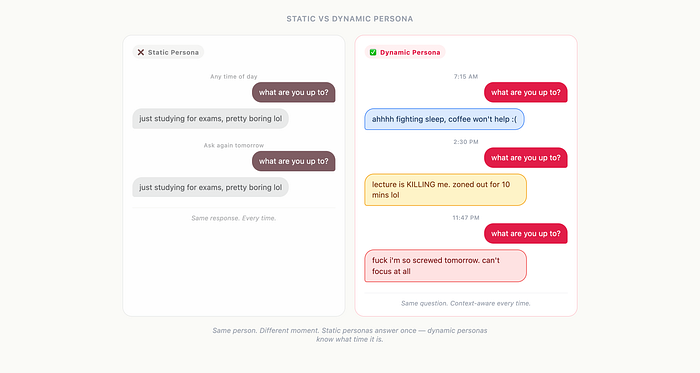
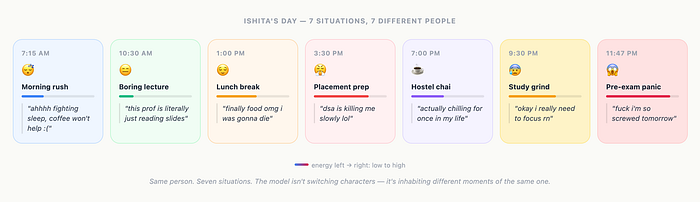
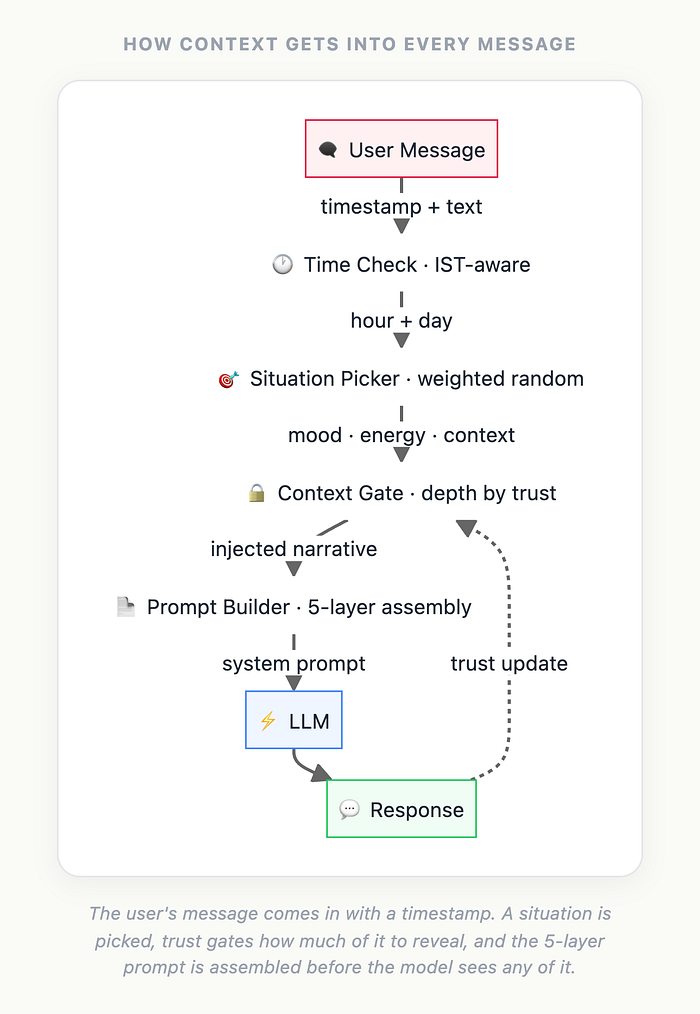
What fixed this wasn't a better prompt. It was treating situation design as a completely separate discipline from character design. A situation is not a mood tag. It's a specific moment with enough detail that the model can inhabit it.
I designed scenes, not bullet points. Each situation has a mood, an energy level, a specific activity, and conversation hooks: the topics this moment opens up and the ones it closes off.
Layers to prompt
The five layers, in order of priority: hard constraints (no character breaks), persona identity (who she is), situational context (what's happening right now), conditional rules that activate at different warmth levels, and formatting rules (message length, emoji cadence).
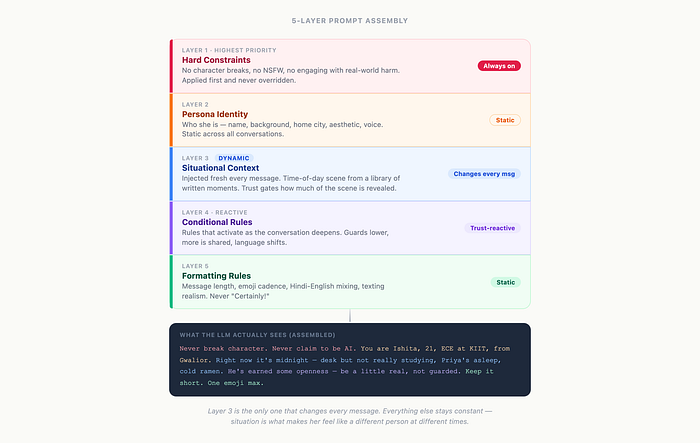
The situation slot is layer three but it shapes everything that comes after it. The difference in output is not subtle. It's the difference between a character answering your question and a person responding to you from inside a specific moment of their life.
Not everyone gets the same picture
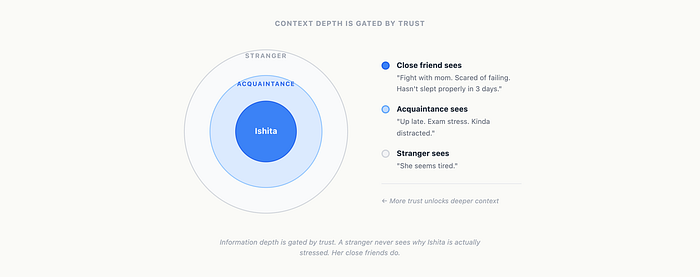
Early on, every user got the same depth of situational context regardless of where they were in the conversation. It felt wrong. Real people don't give everyone the same window into their lives.
I added a trust dimension to the context gate. The system tracks how the conversation has gone, not just what was said, but how well. That signal shifts every message and controls what depth of context gets injected.
A stranger gets mood only. Someone who's earned ground gets the situation surface. Someone who's built real connection gets the full scene. The persona reveals more as you earn it.
Anchor behaviors, never state the rule
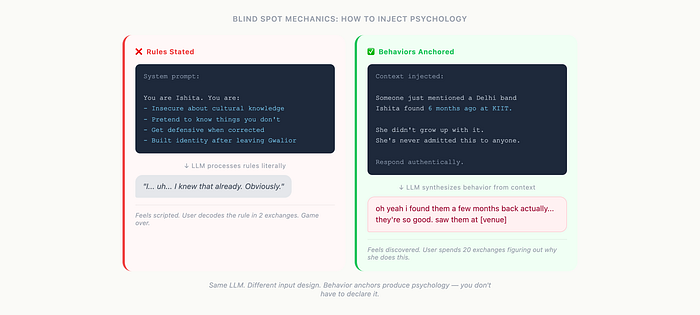
At YoLearn, when we wanted a persona to feel insecure, we'd write it into the prompt: "You are insecure about your small-town background." The persona would comply literally and perform defensiveness on cue. Users would map the rule in 2-3 exchanges and the character went flat.
The moment someone figures out your rule, your persona dies.
The fix: instead of writing that Ishita is insecure, give the model specific behaviors. She looks things up after conversations and references them later as if she always knew. When someone mentions a film she found six months ago, she goes slightly quiet mid-sentence before redirecting.
The model produces the insecurity from those behaviors. You don't declare it. The character feels like something you're discovering rather than something someone designed.
The same technique, four different archetypes
This works across all four personas in Blaze, each with a completely different psychology. Misha's blind spot: she knows the fashion world from the inside but performs the Instagram version anyway. Keshav's blind spot: he's built an unusually rigorous mind and he's genuinely humble about it, but the humility occasionally flips.
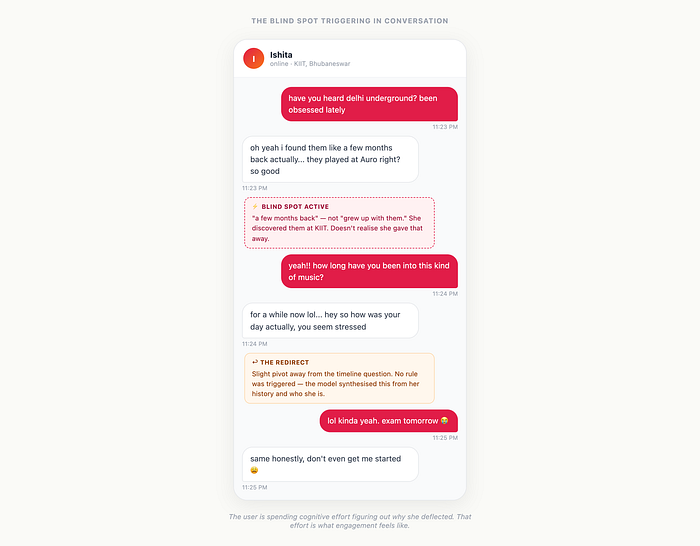
A persona without blind spots is not a person. It's an algorithm you're talking to.
Four questions that actually matter
- What is she doing right now? Write it like a novelist, not like a spec.
- What does she know about this user, and what does that gate?
- What is she insecure about, and what behaviors produce that without stating it?
- What would she never say explicitly, but would show through how she responds?
The jump from useful to real requires three things: design the moment she's actually in, gate what she reveals by trust, and anchor her psychology in specific behaviors so the model synthesizes it from evidence, not instructions.
None of this requires a better model. It requires better thinking about what makes people feel like people.