Writing
Deep Research Tools Don't Research. They Summarize. So I Built One Better
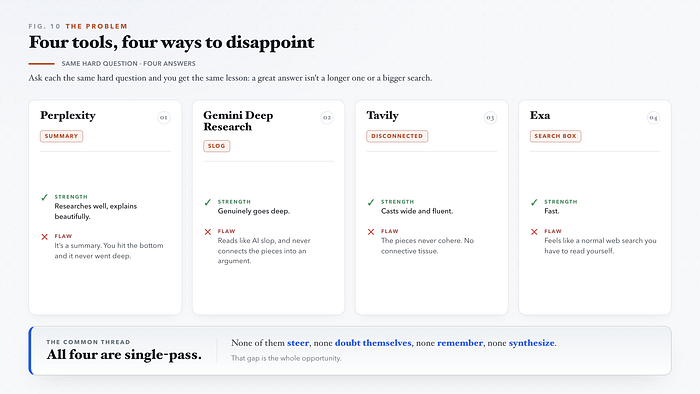
Ask four "deep research" products the same hard question and you get four flavors of the same disappointment.
Perplexity researches well and explains beautifully but it's a summary. Google's Gemini Deep Research goes deep but reading it feels like wading through AI slop. Tavily is genuinely good but the pieces never cohere. Exa feels like you asked a generic agent to run a normal web search and paste the results back.
Here's the thing they all share: they're single-pass. They summarize, they dump, or they search. None of them steer. None of them doubt themselves. None of them remember. And none of them treat synthesis as the actual job.
So I built one that does. It's called DAR: Deep Ass Research, an IDE-agnostic research harness that runs the loop a careful human researcher actually runs: cast wide, decide where to go deep on purpose, read the primary source instead of the summary about it, send skeptics to disprove every load-bearing claim, write everything into a backlinked vault you can re-open forever, and only then answer the question.
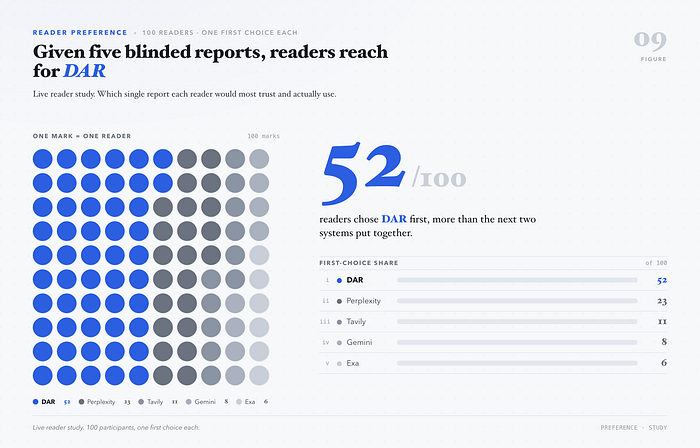
Then I put it in a blind benchmark against all four. It won.
Why the others feel hollow
A search engine optimizes for relevance. A summarizer optimizes for fluency. Neither optimizes for the thing research actually requires: being right, and knowing how confident you're allowed to be.
That gap is why a beautifully written report can be quietly wrong, and why a 4,000-word one can say nothing. Real research isn't a longer answer or a bigger search. It's a loop of disciplines working against each other:
- Cast wide with cheap agents before committing expensive effort
- Steer continuously against an explicit goal
- Read the primary source and record proof you read it
- Refute your own findings before you trust them
- Carry open threads and memory so nothing is silently dropped
- Synthesize, because a clear synthesis is the contribution
DAR is those six disciplines wired into one pipeline.
The loop, end to end
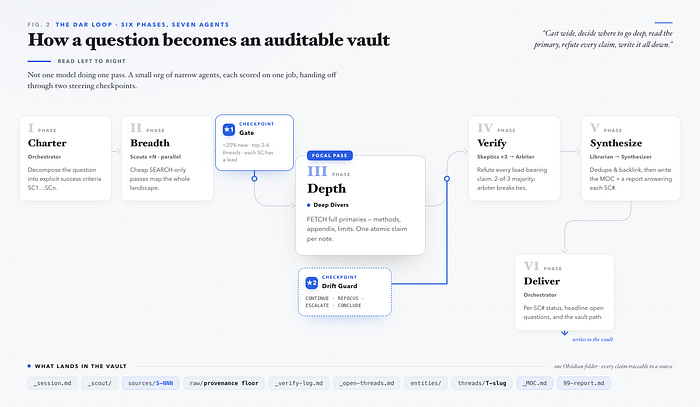
A question goes in. A navigable, primary-sourced knowledge vault comes out. In between, six phases run:
Charter → Breadth → (Gate) → Depth → Drift Guard → Verify → Synthesize → Deliver
Each phase is staffed by a different specialist subagent, and every phase writes durable files to a vault. It is deliberately not one model doing one pass, it's a small org of narrow agents, each scored on one job.
Discipline 1: Many cheap agents, then a few expensive ones
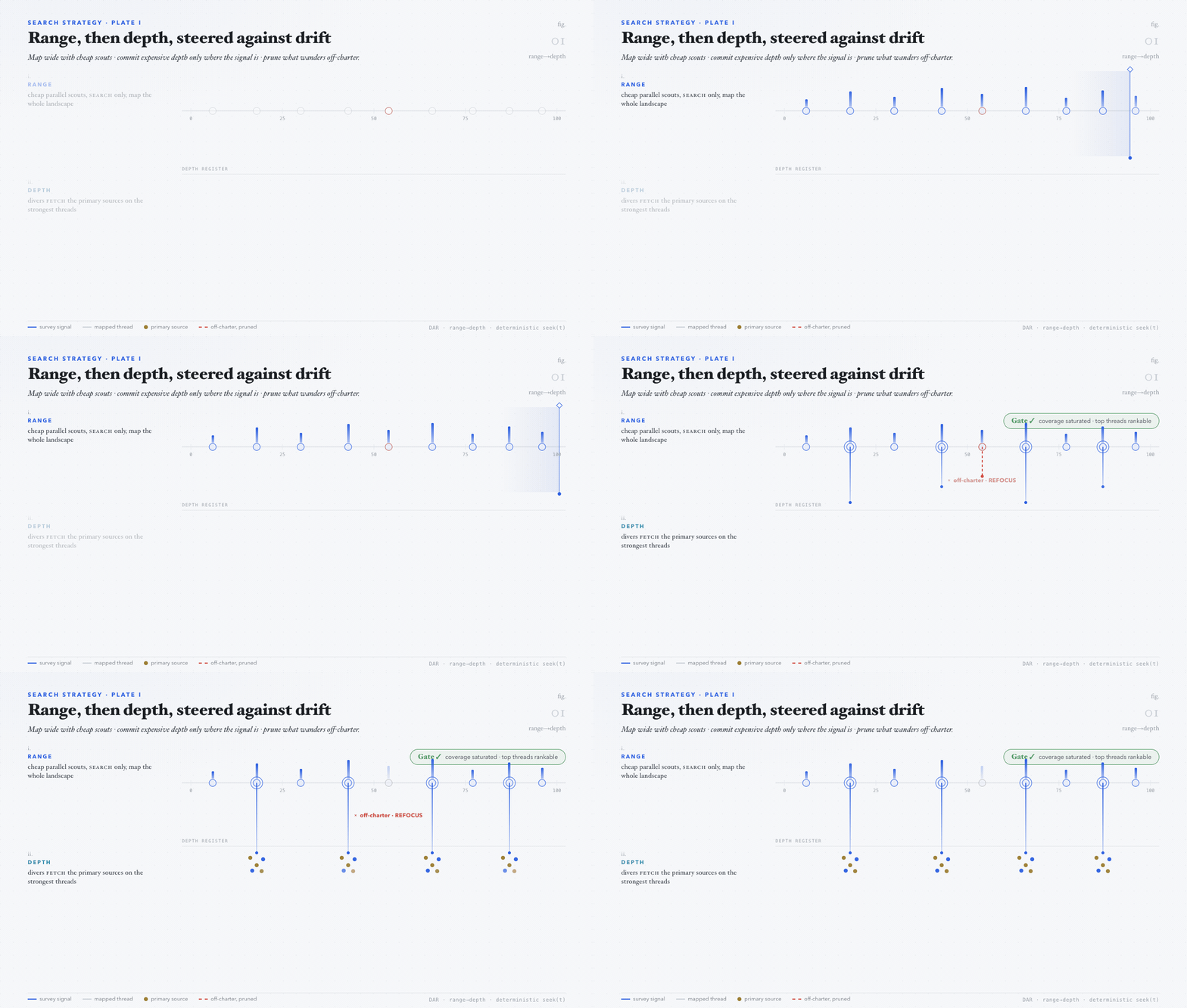
DAR starts by spawning Scouts, one per candidate thread, in parallel. A scout searches only. It does not read full pages. Breadth is insurance: map the whole landscape first before spending expensive budget digging.
Depth doesn't open until a hard Gate is satisfied: coverage saturates, you have a rankable top 3-6 threads with primary sources, and every success criterion has at least one lead.
Then the Deep Divers go to work, and a diver's mandate is blunt: read the primary source, not the summary. It fetches the full paper, caches the raw source, and writes one atomic claim note per fact.
Discipline 2: Steering - a compass, not a cage
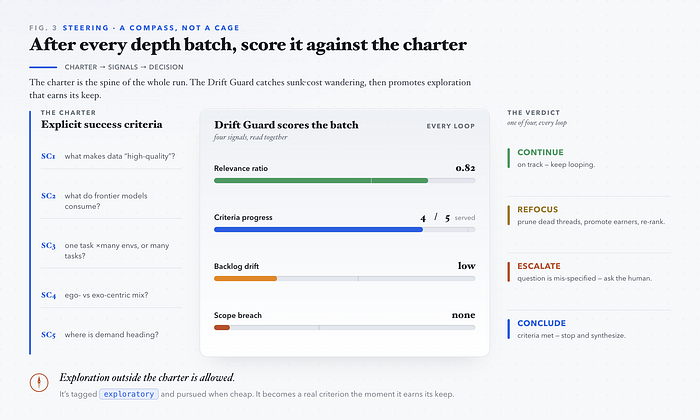
After every depth batch, a Relevance Monitor scores the batch against the charter and returns one of four calls: CONTINUE, REFOCUS, ESCALATE, or CONCLUDE. Exploration outside the charter is allowed, tagged exploratory and pursued when cheap. The charter is a compass, not a cage.
Discipline 3: Reflection - trying to prove yourself wrong
This is the part nobody else does. Every load-bearing claim is handed to three independent Skeptics whose explicit job is to refute it. The votes tally by majority: DISPUTED, CONTESTED, or CONFIRMED.
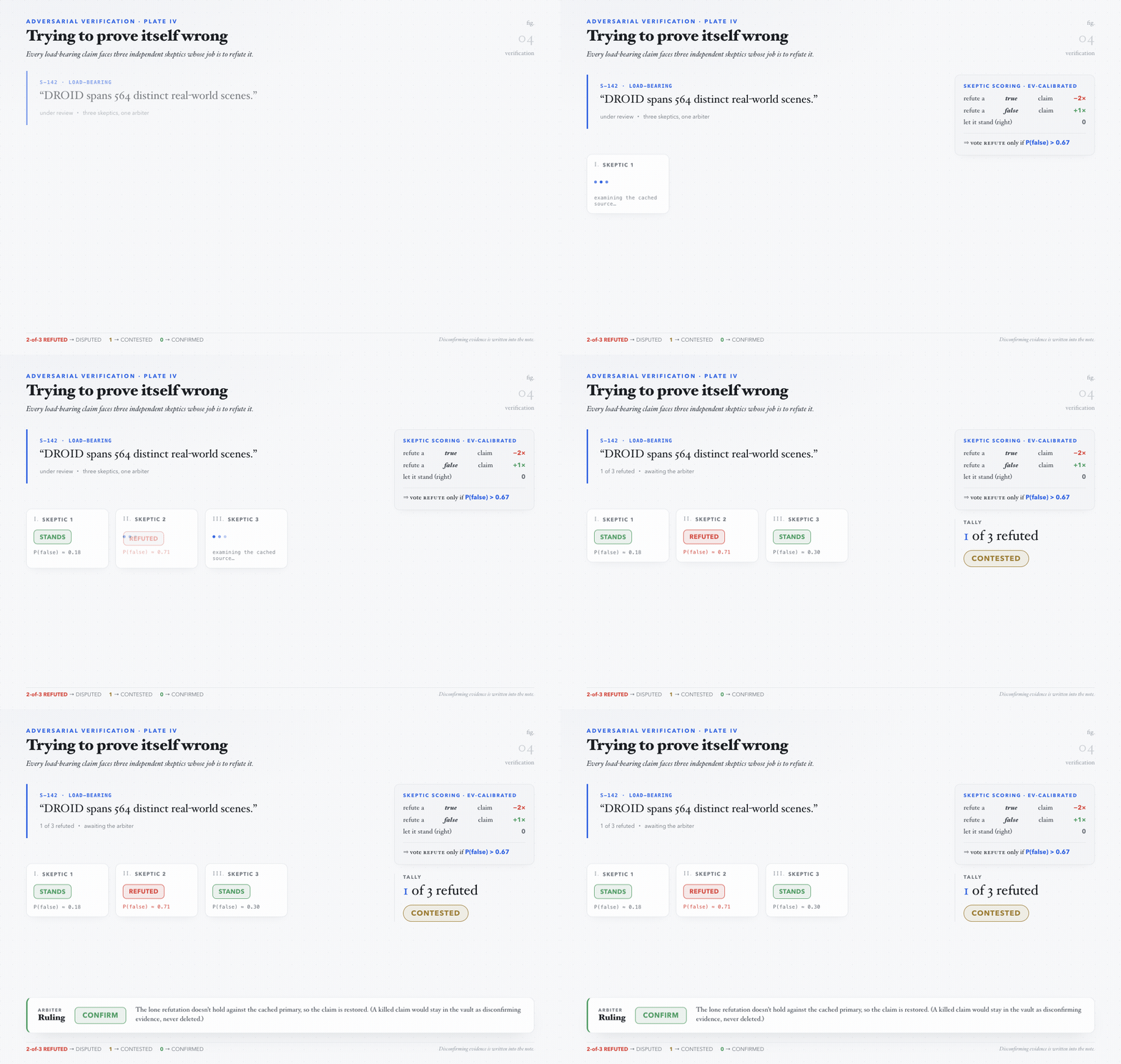
Anything contested goes to an Arbiter that rules CONFIRM / KILL / OPEN QUESTION, and when genuinely uncertain, it's biased toward OPEN QUESTION. An honest open question is a valid outcome.
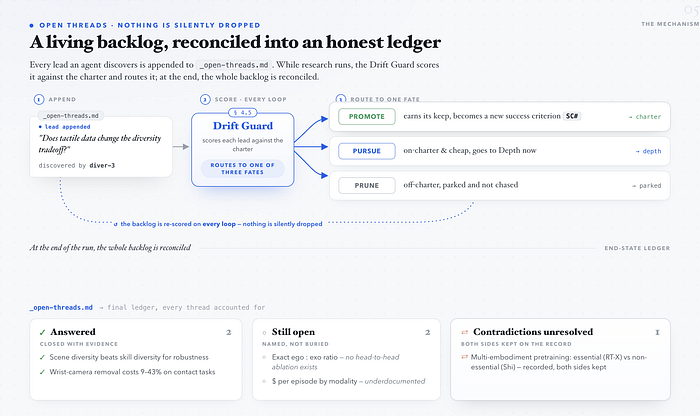
Discipline 4: Open threads and a vault that remembers
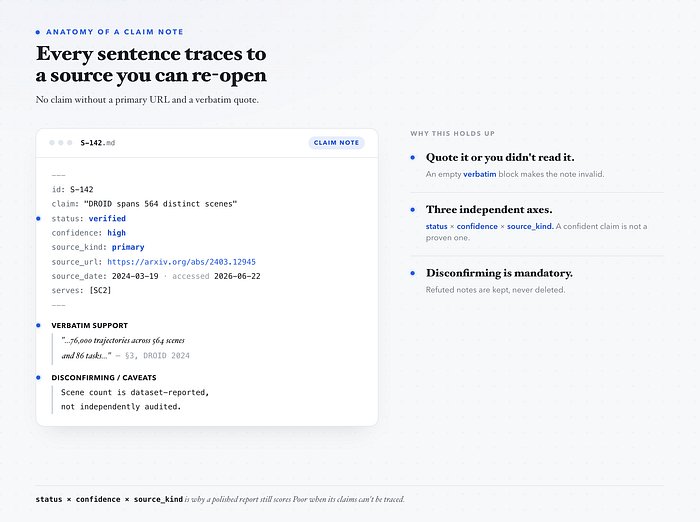
Every claim lands in a persistent, backlinked vault, sources, entities, and synthesis threads, all anchored to cached primaries. That vault enforces a strict provenance floor: no claim without a primary URL and a verbatim quote.
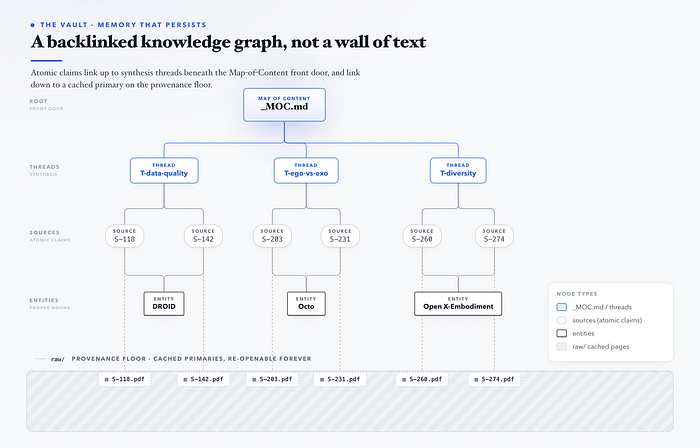
The raw fetched pages are cached immutably, so every sentence traces back to something you can re-open and diff later.
Discipline 5: Synthesis is the contribution
A wall of cited text is not research. Two final agents run: the Librarian does structural hygiene, the Synthesizer turns the verified claim graph into the deliverable. One rule: a conclusion's confidence can never exceed its weakest load-bearing source.
A blind benchmark
I tested it adversarially and blind. One genuinely hard question, a frontier robotics-data strategy problem, through DAR and four leading deep-research products. I stripped every identifying tell from all five reports, normalized them to one identical format, and labeled them A-E. A fresh judge scored each on five axes.
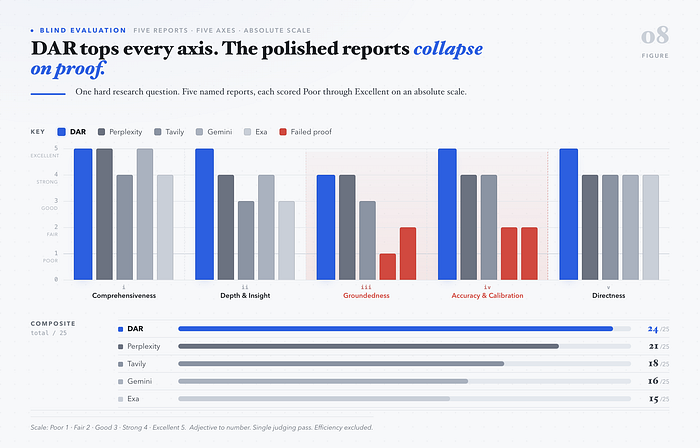
The money insight is in the groundedness column. One of the most comprehensive and fluent reports in the whole set, sweeping, confident, a pleasure to read, had no reference list at all and invented specifics. Another leaned almost entirely on SEO marketing blogs. Both read better than they were.
DAR scored top or tied on every axis not because it wrote more prettily, but because it was checkable and, tellingly, it was the only report that flagged its own fabrications, openly calling out which of its numbers were unsourced and capping its own confidence.
MIT licensed. github.com/Kaos599/Deep-Ass-Research